Forex trading in Kenya has become one of the most structured and regulated markets in Africa. While many African countries are still figuring out how to manage online trading, Kenya has taken a bold step by creating a clear regulatory framework that protects traders and encourages transparency. This article explores how regulation shapes forex trading in Kenya with CMA licensing and M-Pesa integration to local broker dominance and how Kenyan traders balance compliance with profitability.
The Growth of Forex Trading in Kenya
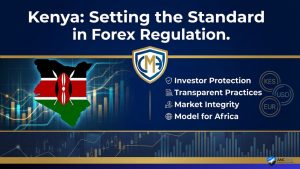
Forex trading in Kenya has grown rapidly over the past few years. The improved internet access, mobile money innovation, and a tech-savvy youth population made Kenya to become one of the most active forex trading hubs in East Africa. Unlike in many African countries, forex trading in Kenya is regulated by the Capital Markets Authority (CMA). This regulation gives traders confidence that they are dealing with licensed brokers who follow strict financial standards. The African forex market is expanding, and Kenya’s structured approach has made it a model for other countries looking to regulate online trading.
CMA Licensing and Regulation
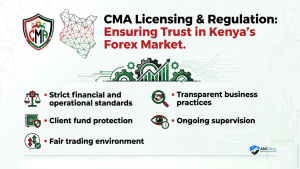
The Capital Markets Authority (CMA) is the body responsible for licensing and supervising forex brokers in Kenya. Every broker that wants to operate legally in the country must obtain a CMA license. This licensing system ensures that brokers.
Maintain transparent operations.
Protect client funds through segregated accounts.
Provide fair trading conditions.
Offer dispute resolution mechanisms.
For traders, this means more security and trust. They can verify a broker’s license on the CMA website before opening an account. However, regulation also comes with limits. Some traders feel that strict compliance rules make it harder for smaller brokers to compete, which can reduce variety in the market.
Forex trading in Kenya
M-Pesa Integration and Payment Systems
One of Kenya’s biggest advantages in forex trading is M-Pesa, the country’s leading mobile money platform. M-Pesa has made deposits and withdrawals fast, easy, and accessible to almost everyone. Most forex brokers in Kenya now integrate M-Pesa directly into their platforms, which allows traders to fund their accounts instantly and withdraw profits within minutes without needing a bank account or credit card. This payment convenience has made forex trading in Kenya more inclusive. Even traders in rural areas can participate in the global market using just a smartphone and M-Pesa.
Local Broker Dominance
Kenya’s regulatory environment has encouraged the increase of local forex brokers. These brokers understand the Kenyan market better and offer services personalized to local needs, such as M-Pesa deposits, local customer support, and educational programs.
Some of the most popular CMA-licensed brokers in Kenya include.
EGM Securities (FXPesa)
Scope Markets Kenya
Pepperstone Kenya
These brokers compete with international platforms but maintain a strong local presence. Their dominance shows how regulation can empower homegrown companies to thrive in the African forex market.
Government and Regulatory Stance
The Kenyan government views forex trading as a legitimate financial activity as long as it’s done through licensed brokers. The CMA regularly issues warnings against unlicensed platforms and educates the public about trading risks. This proactive stance has helped reduce scams and build trust in the market. It also positions Kenya as one of the few African countries where forex trading is both legal and properly supervised. However, regulation also means traders must follow strict verification processes, tax compliance, and anti-money laundering rules. While this adds extra steps, it also protects the integrity of the market.
For many Kenyan traders, forex trading is more than just a side hustle, it’s a path to financial independence. Local traders often share stories of how they started small, learned through online communities, and gradually built consistency. The reality is that forex trading requires patience and discipline. Profits don’t come overnight. Successful traders focus on risk management, continuous learning, and emotional control. The good news is that Kenya’s regulated environment gives traders a fair chance to succeed with access to licensed brokers, reliable payment systems, and strong community support, Kenyan traders are better positioned than many of their African counterparts.
Balancing Compliance with Profitability
Kenyan traders often face the challenge of balancing compliance with profitability. Regulation ensures safety, but it can also limit leverage and trading flexibility. To stay profitable, traders focus on strategy, education, and proper risk management rather than chasing high leverage or quick wins. Many also diversify their income by combining forex trading with other digital ventures like crypto trading, affiliate marketing, or online tutoring. This balanced approach helps them stay compliant while still growing their trading accounts sustainably.
Summary
Forex trading in Kenya stands out as one of the most organized and transparent markets in Africa. With the CMA licensing, M-Pesa integration, and local broker dominance, Kenya built a trading ecosystem that prioritizes safety, accessibility, and growth. While challenges remain such as limited broker options and strict compliance rules, the benefits far outweigh the drawbacks. Kenyan traders continue to prove that with the right tools, education, and discipline, success in the African forex market is achievable.
⇒Next in our Forex Trading Across Africa series, we’ll explore Forex Trading in South Africa
Stay tuned for the next article in the series.
Subscribe to our blog for more trading insights, expert analysis, market updates and strategies – join our telegram community today!
Emmanuel crafts insightful data-driven stories on Finance, Forex, Cryptocurrency, Investment, Stocks, and Startups. As Editor-in-Chief at ANC Blog, I help our readers learn the ropes of the finance and startup ecosystem.