Swap-free forex accounts remove the overnight interest charge, but most brokers replace it with a different cost, so the fees you check matter more than the label. Before you open one, read the account terms, add up the all-in cost, test it on a demo and confirm the broker’s regulation. Then ask a qualified scholar whether the structure suits your own beliefs.
As traders, we hear the same worries again and again. Will a holding fee eat my overnight gold trade? Is there a hidden cost? Can I trust the broker with my withdrawals? This guide answers those questions for Muslim traders in the Middle East, Asia, Africa and Europe.
What Are Swap-Free Forex Accounts?
Swap-free forex accounts, also called Islamic accounts, are trading accounts that do not charge or pay overnight interest on open positions. They exist so that traders who avoid interest can still access the forex market. However, “swap-free” does not mean “cost-free”. The broker still has to cover the cost of keeping your position open, and it usually does that another way.
What swap or rollover means
When you hold a leveraged position past the daily cut-off, the broker rolls it over to the next day. That roll applies a swap, which reflects the interest rate gap between the two currencies in the pair. You can pay it or earn it, depending on your direction. Many brokers also charge a triple swap on one day a week to cover the weekend.
Why Islamic Accounts Exist
Islamic finance prohibits riba, which means interest. A normal swap is based on interest rates, so many Muslim traders avoid it. As a result, brokers began to offer accounts with the swap removed.
One point matters here: the account is a broker product, not a religious certificate. Admirals, for example, says on its own Islamic account page that it is not a religious institution. Scholars also do not all agree, as we cover below.
How Brokers Recover the Cost on Swap-Free Forex Accounts
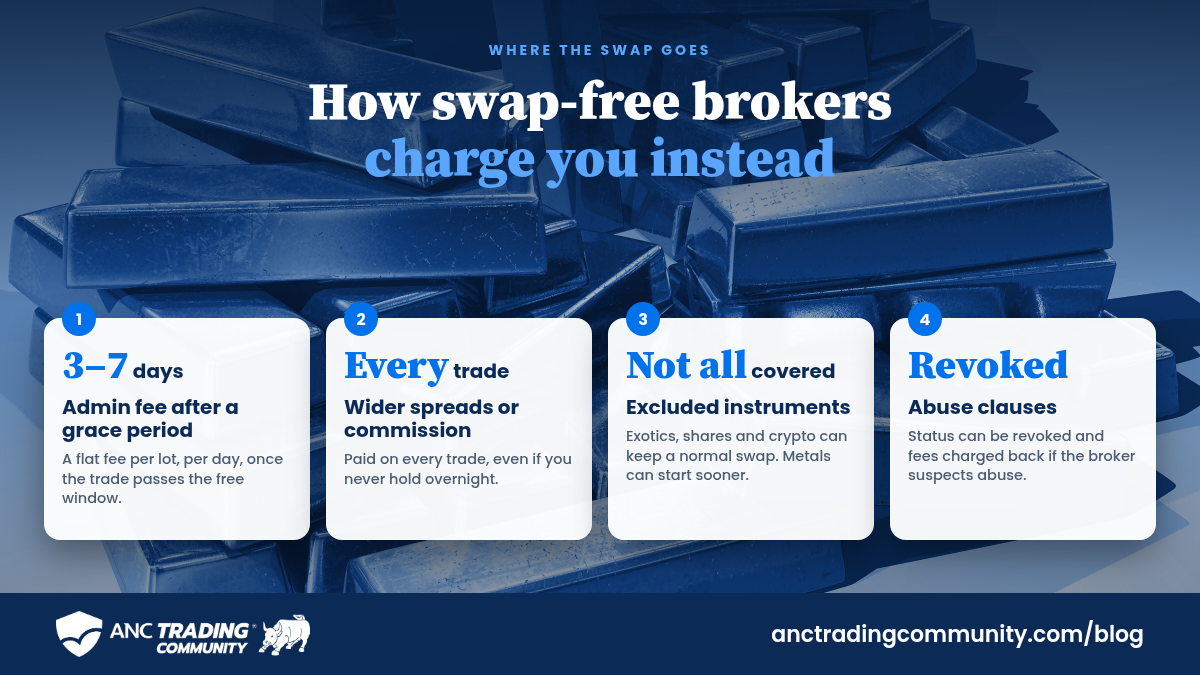
A broker pays its liquidity providers to hold your position, so the cost does not vanish. Swap-free forex accounts simply move it into one of four places.
Admin Fees on Swap-Free Forex Accounts
This is the most common model on swap-free forex accounts. You pay nothing for the first few days, then a flat fee per lot for each day the trade stays open. The fee is not meant to be interest. It is a fixed charge, and it often differs by instrument. Gold and other metals usually cost more than major pairs, which matters if you hold gold overnight.
Wider Spreads on Swap-Free Forex Accounts
Some brokers skip the holding fee and widen the spread or add a commission instead. This hurts short-term traders most, because you pay on every trade. A scalper who never holds overnight may be better off on a standard-spread account with admin fees that never trigger.
Excluded Instruments
Swap-free status often covers only some markets. Exotic pairs, crypto and some indices or shares may still carry a normal financing charge. FXGT, for example, states that swaps still apply to FX exotics and stocks after one day on its Islamic account.
Abuse clauses
Published swap-free terms from several brokers let the firm revoke the status at any time. They can also charge fees back to the start of the trade if they suspect abuse, such as swap arbitrage or carry trades. FXGT’s page, for instance, says the company may revoke swap-free status in the event of abuse.
Real Examples From Broker Pages
Terms change, so treat these as examples, not a ranking. They come from each broker’s own page, read on 15 November 2026.
-
- Admirals: a flat admin fee once a trade is open for more than 3 days, or 1 day for metals, energies, crypto and exotic pairs. It says standard spreads and commissions apply, with no spread widening.
-
- ACY: no admin fee for the first 4 days. After that, a daily fee per lot applies, listed at $12.50 on major forex pairs and $27.50 on major metals.
-
- Pepperstone: a $100 admin charge per standard lot on FX and precious metals once a trade has been held for 5 days. Its page lists Malaysia, Indonesia and Pakistan among eligible countries.
-
- FXGT: admin fees start after 7 days on most pairs, but after only 2 days on JPY pairs. Swaps still apply to exotics and stocks.
Notice how far apart these are. For swap-free forex accounts, a 3-day grace period and a 7-day period can decide whether a trade costs you anything at all.
How to Check Swap-Free Forex Accounts Step by Step
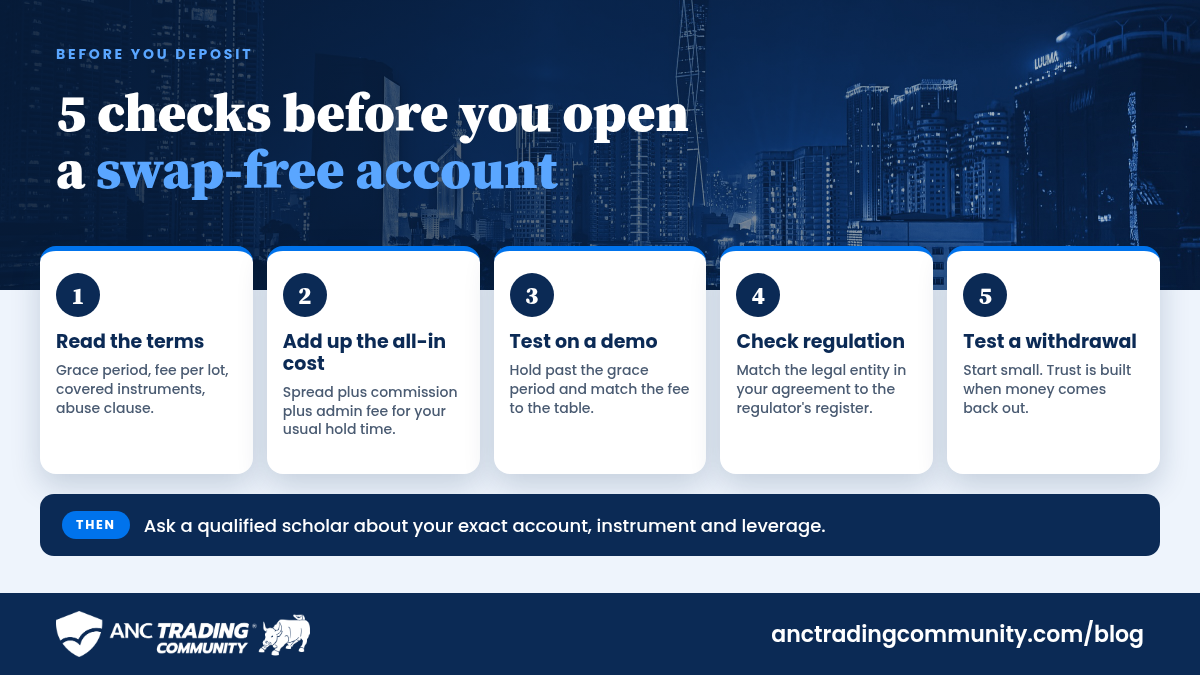
Follow these five checks before you fund any of the swap-free forex accounts you are weighing.
-
- Read the swap-free terms, not the ad. Find the grace period, the fee per lot, the instruments covered and the abuse clause. Next, check how weekends are counted. Admirals, for example, says it charges a 3-day fee on Saturdays.
-
- Work out the all-in cost. Add the spread, any commission and the admin fee for your usual holding time. Then compare brokers on that total.
-
- Test it on a demo. Hold a small position past the grace period and watch the fee appear on the statement. Also check that the figure matches the published table.
-
- Check regulation. Confirm the legal entity named in your agreement on the regulator’s own register. If you are unsure how that works, see our guide to the different types of forex brokers.
-
- Test a small withdrawal. Trust is built when money comes back out. Our piece on client fund protection and denied withdrawals explains what to look for.
A simple cost example
Here is a made-up example, so you can see the maths. Say a broker charges $10 per lot per day after day 3. You hold 2 lots for 10 days. That is 7 chargeable days, so 7 × $10 × 2 = $140.
Gold and overnight holds
If you trade gold on swap-free forex accounts, look at the metals line first. Many swap-free tables charge more for metals and start sooner. Our gold trading guide for beginners explains how sessions and risk shape how long you hold. Also, watch for scam groups that promise “free” Islamic accounts, and read our list of red flags of fake trading platforms.
What Scholars Say: Ask Before You Trade
Religious opinions on swap-free forex accounts differ, and we do not issue rulings. Some scholars and fatwa bodies accept spot currency trading when settlement is immediate and no interest applies. Others say leveraged accounts remain impermissible even when swap-free, because of margin lending and the lack of real possession. Some also ask whether an admin fee is a true service charge or interest under another name.
So please speak with a qualified scholar you trust about your exact account, instrument and leverage. If it helps, also check which brokers serve your country on our regulated brokers by country page.
FAQ: Swap-Free Forex Accounts
What is a swap-free forex account?
It is an account with no overnight swap or interest on open positions. Most brokers still charge an admin fee, a wider spread or a commission instead.
Are swap-free forex accounts really free?
No. Many brokers charge a flat admin fee per lot after a grace period. Others widen spreads. Always compare the all-in cost of swap-free forex accounts.
Is a swap-free forex account halal?
Scholars differ, and this guide does not issue rulings. Some accept it under strict conditions, while others reject leveraged trading altogether. Ask a qualified scholar about your account.
How do brokers earn money on swap-free forex accounts?
Brokers earn from spreads, commissions and admin fees. Some also exclude exotic pairs, crypto or shares, which keep a normal financing charge.
Can swap-free forex accounts hold gold overnight?
Often yes, but metals usually carry higher admin fees and may start sooner. Check the metals line in the fee table.
Can a broker take away my swap-free status?
Yes, in many cases. Brokers include abuse clauses that allow them to revoke the status and charge fees. Read those terms before you deposit.
Want the desk side of this? Join ANC Trading Community free for the analysis, tools and community. Choosing where to trade? Compare regulated brokers side by side on our broker comparison page, or browse our top broker listing to find the right fit.

Go Beyond the Charts, hosted by ANC Trading Community, is an exclusive FX VIP business meeting on 22 November 2026. It is free to join. So register to attend and meet leaders, brokers and serious traders in one room.
Risk warning: Forex and CFDs are complex instruments and come with a high risk of losing money rapidly due to leverage. A high percentage of retail investor accounts lose money when trading CFDs. This article is for information only. It is not investment, tax or religious advice. Not directed at residents of the EU/EEA/UK, India, Pakistan, the Philippines, Malaysia, Indonesia, Vietnam or the United States, where broker promotions are restricted.
Explore more practical guides on the ANC Trading Community blog.