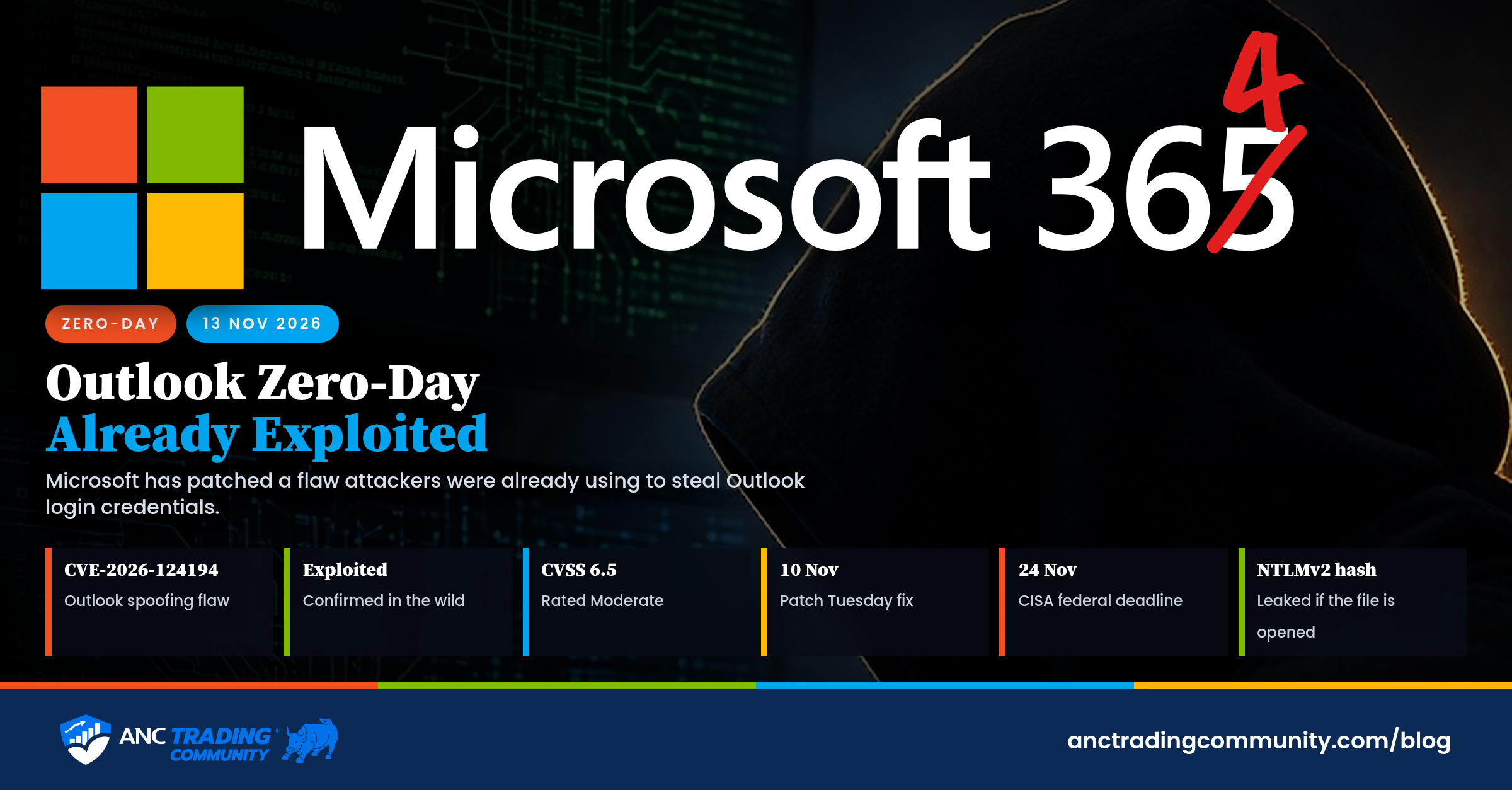
Microsoft has confirmed that attackers were already exploiting a new Outlook zero-day before a patch went out on 10 November 2026. Opening one specially crafted message file can leak a user’s login credentials. For traders, brokers and anyone running a desk on Microsoft 365, that is not a background IT story. It is a live risk to accounts, inboxes and the workflow a trading day actually runs on.
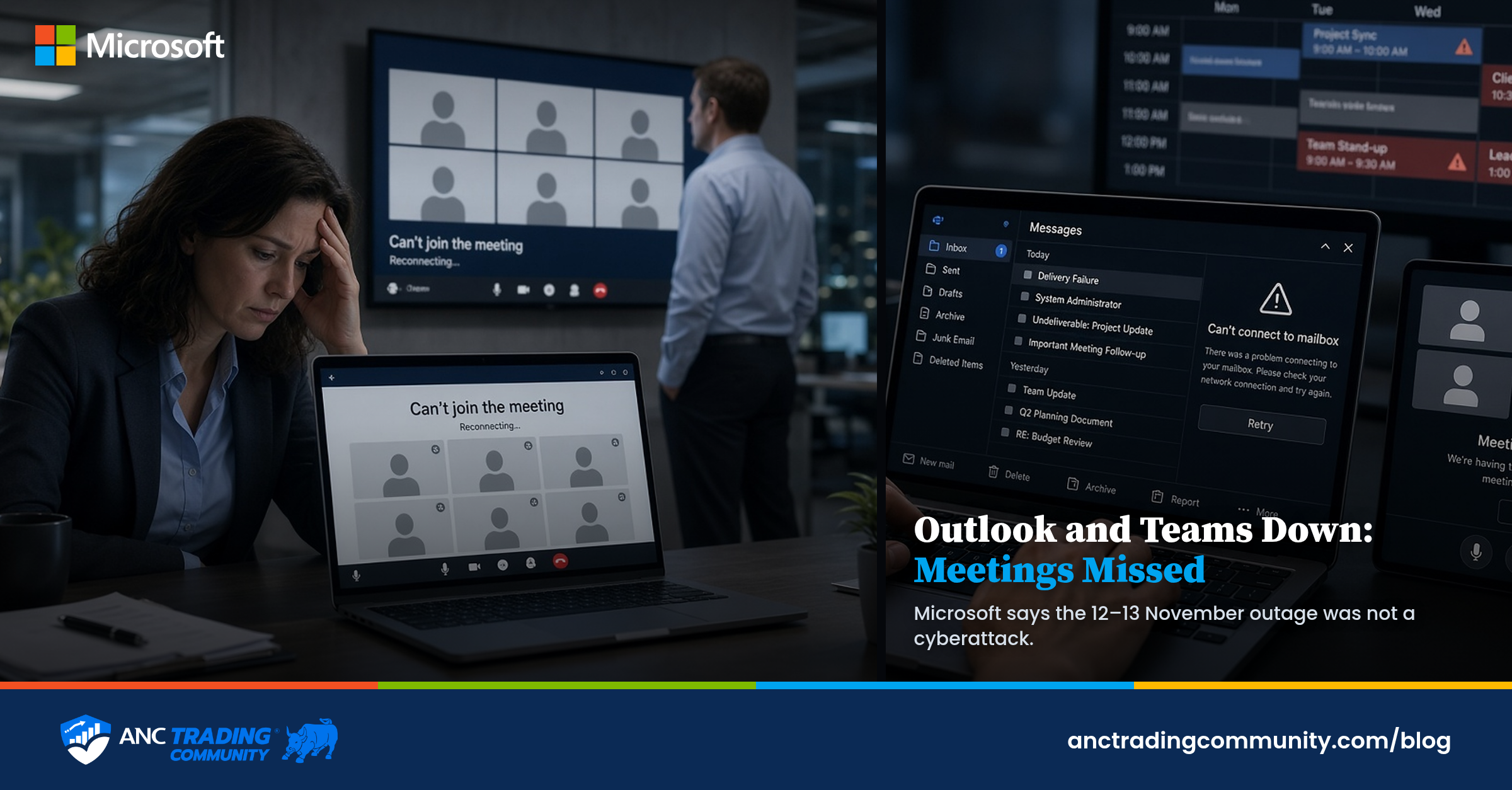
This is the cyber incident. Do not confuse it with the global Microsoft 365 outage that began on 12 November and ran into 13 November, hitting Outlook, Teams and Copilot. Microsoft has said it has no evidence that malicious activity caused the outage.
What the Outlook Zero-Day Actually Does
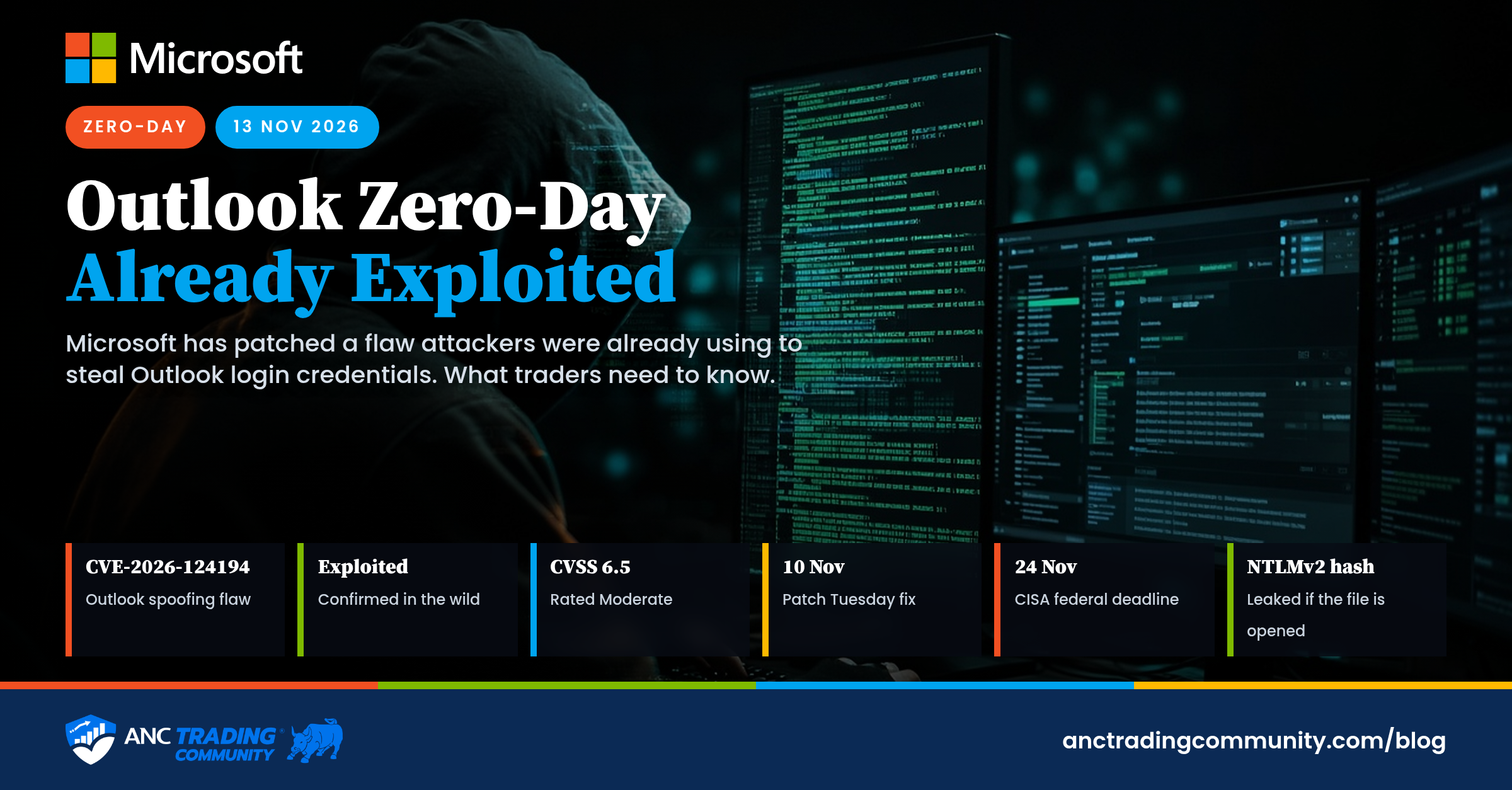
Microsoft tracks the flaw as CVE-2026-124194. Microsoft classifies it as a spoofing vulnerability, rates it Moderate and gives it a CVSS score of 6.5. The modest rating does not mean it is harmless. Microsoft says attackers have already exploited the bug in the wild, and the US Cybersecurity and Infrastructure Security Agency added it to its Known Exploited Vulnerabilities catalog on 10 November, with a federal remediation date of 24 November 2026.
Microsoft’s own advisory is plain:
“An unauthenticated attacker could send a specially crafted message file and convince a user to open it in an affected version of Microsoft Outlook. Opening the file could cause Outlook to connect to an attacker-controlled network location without displaying the usual external-content warning, potentially disclosing authentication information that could be used to impersonate the user.”
That authentication information is the user’s NTLMv2 hash. In Microsoft’s words: “This vulnerability discloses a user’s NTLMv2 hash to the attacker who could use this to authenticate as the user.”
The usual warning that security training tells users to watch for never appears. The Preview Pane is not an attack path. The user has to open the file. Affected products are Microsoft 365 Apps for Enterprise, Office LTSC 2021 and Office LTSC 2024. Microsoft has not said who is behind the attacks, or how many organisations the attackers hit. Microsoft did not publicly disclose the vulnerability before it released the fix.
How Microsoft Has Responded to the Outlook Zero-Day
The patch arrived in Microsoft’s November Patch Tuesday release on 10 November 2026, a round that security coverage, including SecurityWeek, put at 1,094 vulnerabilities across Microsoft products. CVE-2026-124194 was the one Microsoft marked as already under active exploitation.
The fix does not arrive through Windows Update. It ships in the Office updates for the affected products. In Outlook or Word, the path is File, then Account or Office Account, then Update Options and Update Now. If that control is missing or greyed out, the organisation likely manages updates centrally. Microsoft has published fixed builds of 16.0.17932.21140 for Office LTSC 2024 and 16.0.14334.21048 for Office LTSC 2021. Until the update is on the machine, leave unexpected message files and attachments unopened, even when the sender looks familiar.
MSFT, the Outage, and What Moved the Stock
Traders watching Microsoft this week have had two stories running at once, and they are easy to mix up.
The Outlook zero-day is a security problem. The outage is a service failure. Microsoft’s service health dashboard put the start of the outage at 16:17 UTC on 12 November. Users reported problems with Outlook, Teams, Copilot and other Microsoft 365 services that depend on Exchange Online. Email delivery also slowed. Governments, courts, hospitals and businesses around the world reported disruption.
Microsoft has been clear that this is not the hack. The company has said it has no evidence of malicious activity associated with the incident, and that it will publish a post-incident report once mitigation is complete.
The stock still felt it. Microsoft shares closed at $523.00 on 12 November. On Friday 13 November, pre-market reports put the stock down by nearly 3%. In regular morning trade, Investor’s Business Daily reported that Microsoft fell as much as 1.8% to $513.82 before recovering. Those are session moves, not a verdict on the day’s close, and traders should not read them as a reaction to the Outlook zero-day itself. The share price had already been volatile earlier in the week, for reasons market coverage tied more to broader AI and software concerns than to this vulnerability.
For a trader, the point is simpler than a single print. A name as widely held as Microsoft can wobble when its own products go dark. And a trading floor that cannot send or receive email feels operational risk in real time.
This Is Not the Only Recent Microsoft-Related Risk
Two other incidents from the past month belong on the same desk pad, even though they are not this week’s Outlook zero-day.
In mid-October, Microsoft described an active supply-chain attack against ConnectWise Cloud Backup, formerly SkyKick Cloud Backup. Microsoft tracks the threat actor as Storm-0940 and has described it as China-aligned. According to Microsoft, the attackers used compromised application credentials to attempt sign-ins to more than 2,250 Microsoft 365 customer tenants, and in multiple cases obtained privileged cloud access in less than three hours. Huntress, a managed security firm, said it had identified at least 162 compromised tenants in its own environment. Because organisations already trusted the backup application, ordinary multi-factor authentication on user logins did not stop the activity. ConnectWise took the affected service offline. This was not a flaw in Microsoft 365 itself. It was a trusted third-party app that attackers used as a door.
Separately, in late October, Microsoft Threat Intelligence reported two intrusions in which attackers posed as IT or help-desk staff on Microsoft Teams, talked employees into granting remote access, usually through Quick Assist, and then abused insecure Active Directory Certificate Services settings to obtain powerful login certificates. Microsoft was clear that this did not exploit a vulnerability in Teams. It relied on social engineering and weak certificate configurations. In one of the two cases, the attackers copied company data to an external server.
Together, the three stories point in the same direction. The risk is not only a dramatic breach of Microsoft itself. It is attackers using Outlook, Teams and the apps connected to Microsoft 365 as the path in.
What It Means for Traders, Brokers and Platforms
A captured Outlook login is more than an IT inconvenience. For a trader or an introducing broker, email is where password resets, withdrawal confirmations, KYC requests and client instructions travel. If an attacker can authenticate as you, they can read that traffic and, in the worst case, try to act on it.
Brokerages and trading platforms that run on Microsoft 365 have the same exposure at a larger scale. A finance user or an administrator is a high-value target. A help-desk impersonation on Teams, or a trusted backup app with broad permissions, can move faster than a carefully written phishing email. The ConnectWise incident is a reminder to review which third-party apps hold access to the tenant, and how wide those permissions are.
The outage, even though Microsoft says it was not a cyberattack, is a separate lesson. When Exchange Online goes down, trade confirmations, research and client emails can stall. Operational resilience — alternative contacts, phone trees, and not assuming email will always be there — belongs in the same conversation as patching. We saw a similar pattern of security risk spilling into markets in our look at the Binance hack and the US midterms.
What to Do Now
To close the Outlook zero-day, update Outlook and Microsoft 365 Apps as a priority, and confirm the installed build. Do not wait for a Windows Update prompt. If your office manages patches centrally, ask whether IT has already deployed the 10 November Office security updates.
Until the patch is on the machine, do not open unexpected message files or attachments, even when the name in the From line looks familiar.
Turn on multi-factor authentication on email, broker and trading accounts, and use unique passwords. A leaked hash is more dangerous when you reuse the same password.
Treat unexpected IT support messages and calls, including on Teams, as hostile until you have verified them through a channel you already trust. Do not grant remote control because someone claims to be from the help desk.
Review login alerts and recent account activity on your broker and email. If something looks off, contact the firm through a number or address you already have, not through a link in a new message.
Do not keep more on any one venue than you can afford to have locked if you lose access.
Stay Ahead of the Next Outlook Zero-Day With ANC
Want the desk side of this? Join ANC Trading Community free for the analysis, tools and community. Choosing where to trade? Compare regulated brokers side by side on our broker comparison page, or browse our top broker listing to find the right fit.
ANC keeps tracking the security and market stories that actually change how traders work. For related reading, see our profile of Tarik Chebib at Capital.com, VS Markets’ CySEC approval under MiCA, and our MENA broker leadership roundup. And if you want the room where we bring brokers and partners together, register for Go Beyond the Charts.
Go Beyond the Charts, hosted by ANC Trading Community, is an exclusive FX VIP business meeting on 22 November 2026. It is free to join, and it takes you from trading to scaling your forex business. Leaders, brokers and serious traders share one room, so register to attend or join the community free.
Risk warning: CFDs are complex instruments and come with a high risk of losing money rapidly due to leverage. A high percentage of retail investor accounts lose money when trading CFDs. This article is for information only and is not investment advice. Not directed at residents of the EU/EEA/UK, India, Pakistan, the Philippines, Malaysia, Indonesia or Vietnam where broker promotions are restricted.