ESMA forex rules cap the leverage a retail trader in the EU can use. They also close losing trades before an account hits zero, and stop you owing more than you deposit. They grew out of measures that ESMA, the EU markets watchdog, adopted in 2018. This guide from ANC Trading Community explains each rule, and what it means for your margin and withdrawals.
What Are the ESMA Forex Rules?
ESMA is the European Securities and Markets Authority. In March 2018 it agreed temporary “product intervention” measures under MiFIR, the EU markets law. Its ban on selling binary options to retail clients began on 2 July 2018. Then its limits on CFDs, which include rolling spot forex, began on 1 August 2018. For how other markets handle this, see our brokers by country page.
ESMA renewed those limits three times. Then it let the CFD limits lapse at the end of 31 July 2019, because most national regulators had adopted permanent rules at least as strict. So today the ESMA forex rules live on through each country’s watchdog. Examples include the Central Bank of Ireland and Cyprus’s CySEC. You can join ANC Trading Community free to talk through these rules with other traders.
ESMA Forex Rules on Leverage
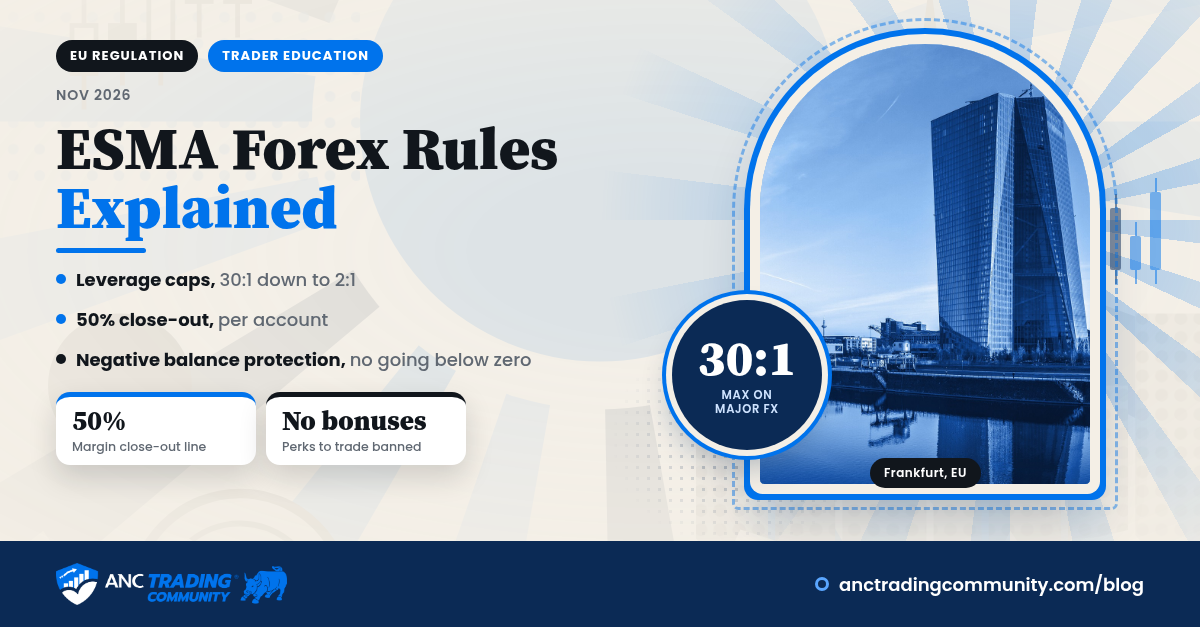
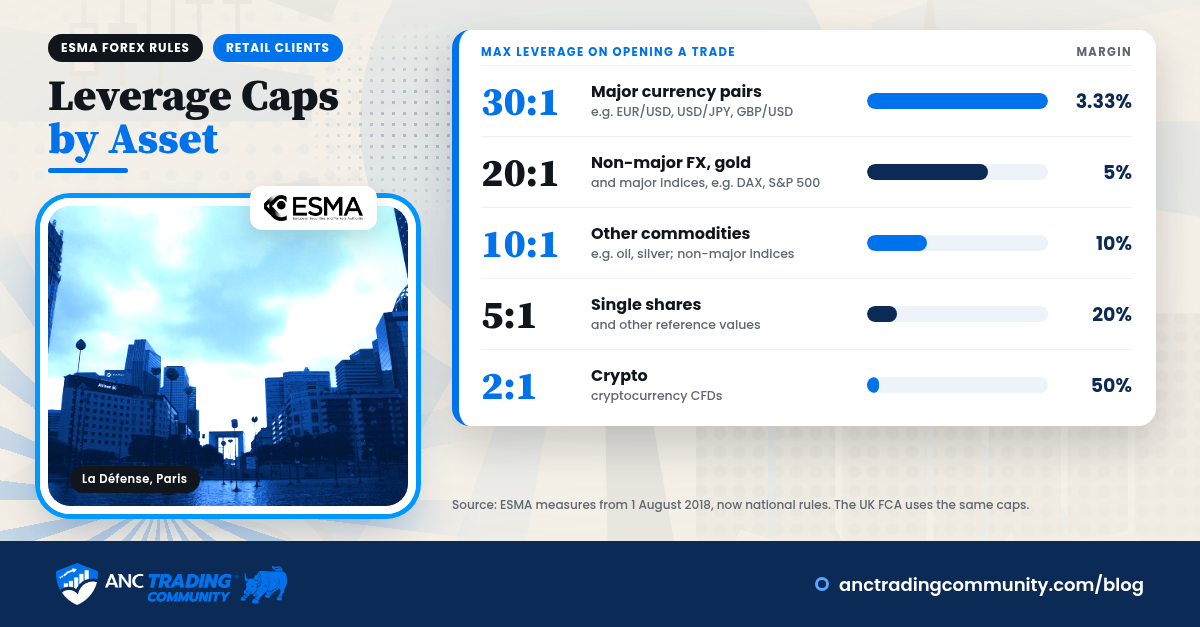
The best-known part is the cap on leverage for retail clients. It depends on how volatile the asset is, so keep it in mind as you browse our top broker listing. Under the ESMA forex rules, the limits on opening a position are:
- 30:1 for major currency pairs. These pair any two of the US dollar, euro, yen, pound, Canadian dollar and Swiss franc.
- 20:1 for other currency pairs, gold and major stock indices.
- 10:1 for commodities other than gold, and for smaller stock indices.
- 5:1 for single shares and anything not listed elsewhere.
- 2:1 for crypto.
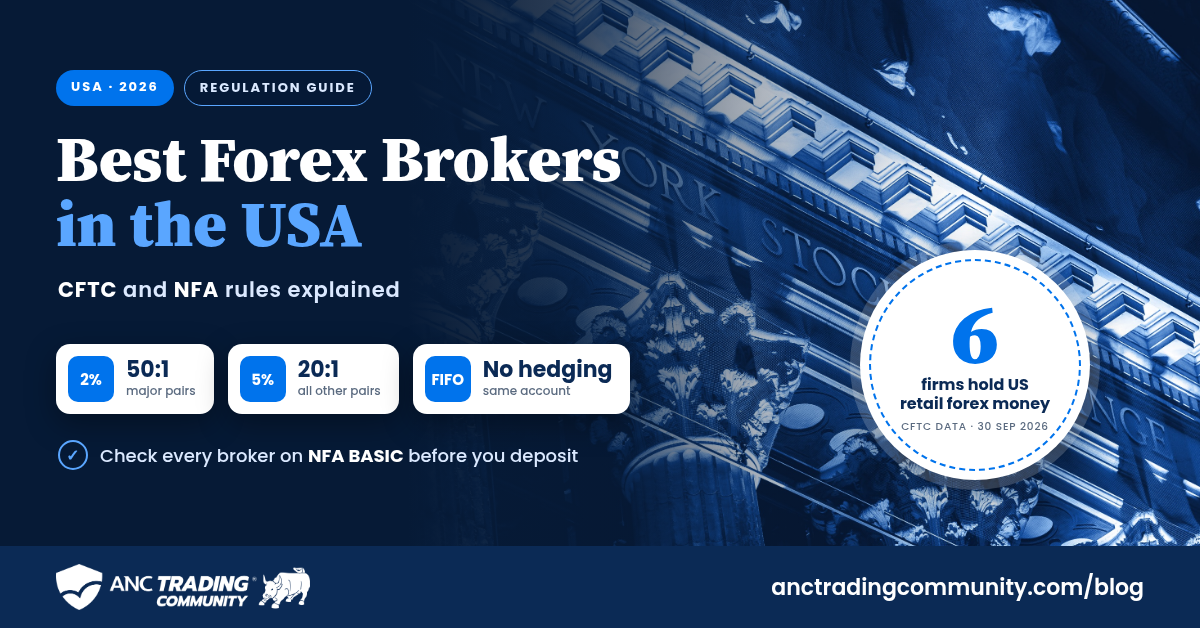
In margin terms, 30:1 means you put up 3.33% of the trade value. Likewise, 20:1 means 5%. So a €30,000 EUR/USD trade needs about €1,000 of margin. By contrast, US rules allow 50:1 on major pairs, as our guide to forex brokers in the USA explains.
The 50% Margin Close-Out Rule
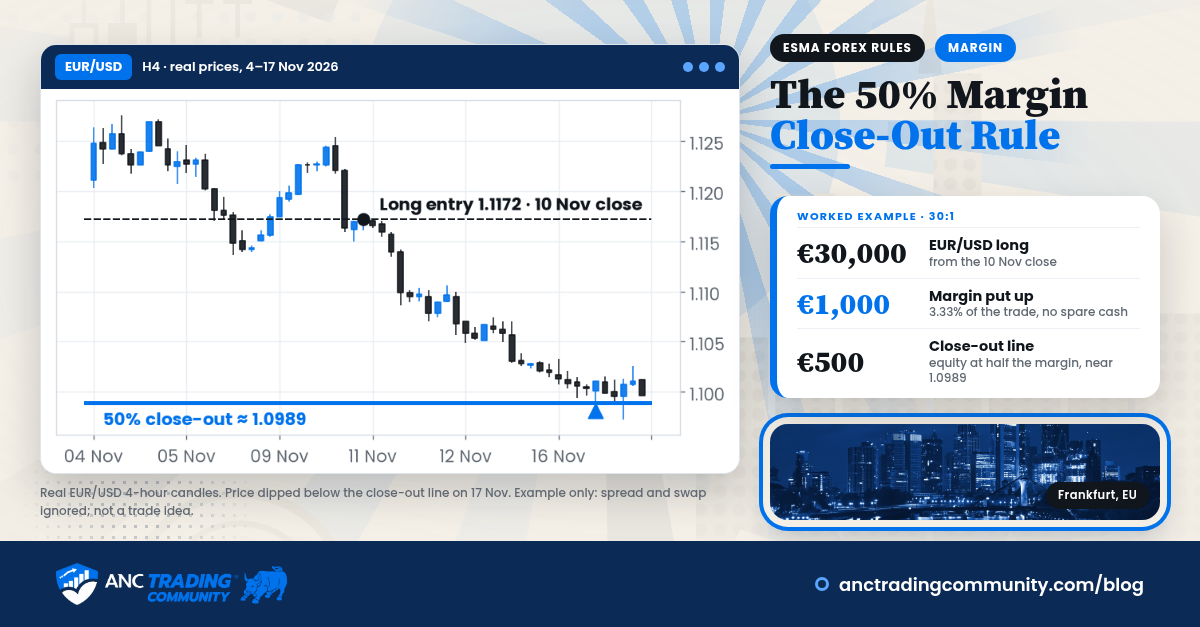
Next comes the margin close-out rule, one every trader in ANC Trading Community should know. It works per account, not per trade. Under the ESMA forex rules, the broker must close trades once your equity falls below half the margin you put up. Equity means cash plus open profit or loss. Say you open trades that need €1,000 of margin. If your equity drops to €500, the broker must start closing.
Before 2018, ESMA found that some firms let funds fall to between 0% and 30% of the initial margin. Now the rule sets a fixed floor. Still, a 50% close-out can hit at the worst moment, so size your trades with that line in mind. Before you choose a firm, check how it shows margin level on our broker comparison page.
Here is how that looks on real prices. Take a €30,000 EUR/USD long from the 10 November close, near 1.1172, with only €1,000 in the account. The close-out line sits near 1.0989, and EUR/USD dipped below it on 17 November. The example ignores spread and swap, and is not a trade idea. Practise this maths with other traders when you join ANC Trading Community free.
Negative Balance Protection
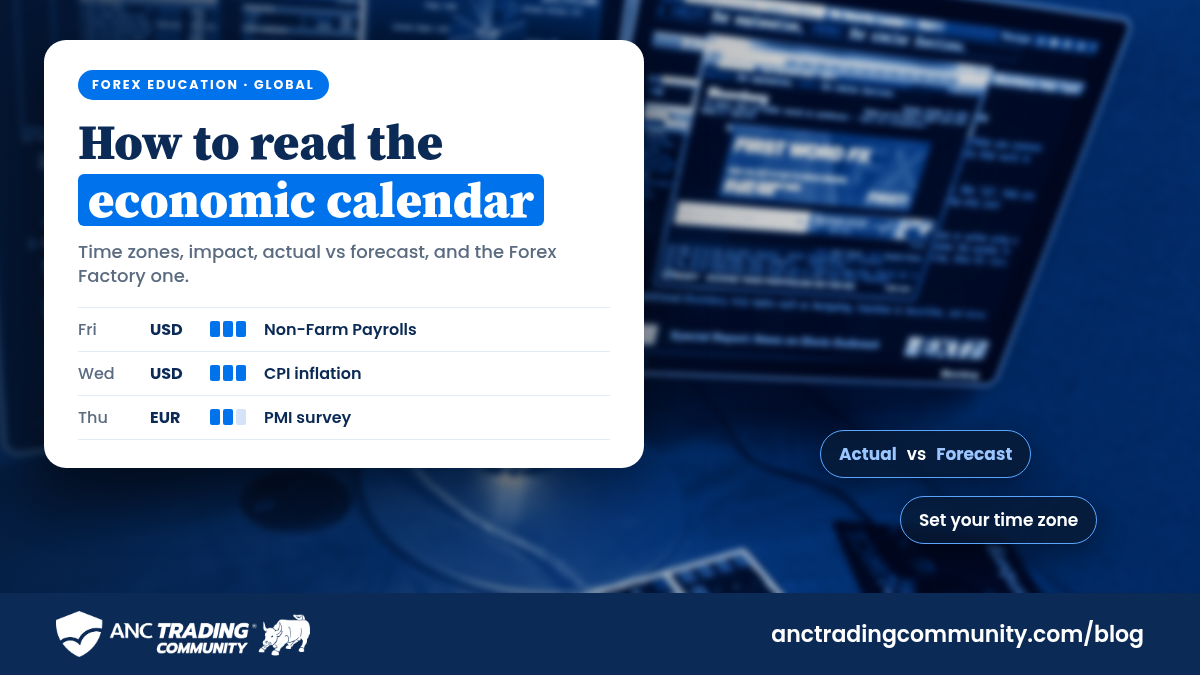
Markets can gap, so a news shock can jump the price past your stop. Because of that, the ESMA forex rules add negative balance protection. It limits your total loss on CFDs to the funds in that CFD account. As a result, you can’t end up owing the broker money. Big data days carry the most gap risk, so learn how to read the economic calendar before you trade them.
No Bonuses, and a Loss Warning
The ESMA forex rules also stop brokers paying retail clients cash or other perks to trade CFDs. That means no deposit bonus and no free gift for funding. Instead, every ad and web page must carry a set risk warning, with the share of that firm’s retail accounts that lost money. The firm works out that figure every three months, over the last 12 months. Our top broker listing is a handy place to compare firms once you know these rules.
When a firm has no figure of its own yet, it uses ESMA’s standard text. That text says between 74% and 89% of retail investor accounts lose money when trading CFDs. So treat that warning as data, not small print. In the ANC Trading Community, we read it before we look at spreads.
Can You Get Higher Leverage as a Professional?
Yes, in some cases. Under MiFID II, a retail client can ask for professional status. If you are weighing it, join ANC Trading Community free and ask the desk first. To qualify, you must meet at least two of these three tests:
- You made trades of large size in that market, about ten per quarter on average over the past four quarters.
- Your portfolio, including cash and investments, is worth more than €500,000.
- You have worked in finance for at least a year, in a role that needs knowledge of these trades.
The firm must also check your skills and warn you in writing. Be careful, though. Once you opt up, the ESMA forex rules no longer shield you. You lose the caps, the 50% close-out and negative balance protection. Before you ask, weigh what you would give up, then compare firms on our broker comparison page.
UK Rules After Brexit
The UK no longer follows ESMA. Instead, the FCA made its own versions permanent. Its binary options ban began on 2 April 2019. Then its CFD rules began on 1 August 2019, with the same caps of 30:1 to 2:1. So in practice, UK retail traders face rules very close to the ESMA forex rules. To see how regulators differ around the world, read our guide to MAS-regulated forex brokers in Singapore.
What Happens if a Broker Fails?
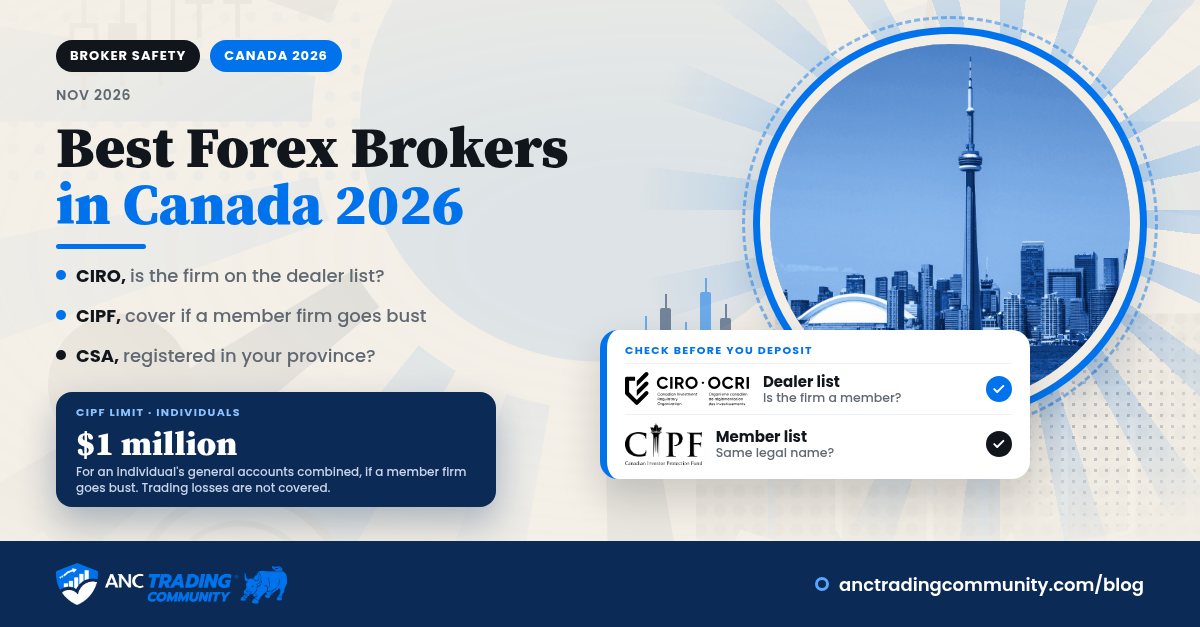
The ESMA forex rules guard you from your own trades. By contrast, investor compensation guards you if the firm goes bust. Under the EU’s Investor Compensation Schemes Directive, each member state must cover at least €20,000 per investor. Some countries pay more. Meanwhile in the UK, the FSCS says it can cover investment claims up to £85,000 per person, per firm. Neither scheme covers trading losses, though. For how Canada handles this, see our guide to forex brokers in Canada.
How ESMA Forex Rules Change Your Trading
These rules change three habits. First, lower leverage means smaller positions, so plan your risk per trade in euros, not in lots. Second, the 50% close-out sets a hard floor, so keep spare margin above it. Third, offshore firms may offer far higher leverage, such as 500:1. Yet that can mean no local watchdog, no compensation scheme and slow withdrawals. Traders in ANC Trading Community look at the licence first and the leverage last.
Also, check the firm’s legal name on your national regulator’s register. Then test a small withdrawal early. Our brokers by country page groups firms by country to help with that first check.
FAQ: ESMA Forex Rules
What is the maximum forex leverage under ESMA rules?
Under the ESMA forex rules, retail clients get 30:1 on major pairs and 20:1 on other pairs and gold. You can line up how firms apply these caps on our broker comparison page.
Are the ESMA leverage limits still in force?
Yes, through national rules. ESMA’s own EU-wide limits lapsed in July 2019, but most national regulators had adopted rules at least as strict. Join ANC Trading Community free to keep up with rule changes.
Do ESMA forex rules apply in the UK?
Not directly. Since Brexit, the FCA runs its own rules, with the same caps and protections. Use our brokers by country page to compare regions.
What is negative balance protection?
It means your CFD losses can’t exceed the money in your CFD account. Confirm it in a firm’s terms before you deposit, then compare firms on our top broker listing.
Can EU traders use offshore brokers for higher leverage?
Some offshore firms accept EU clients. But you give up EU protections, such as negative balance protection. So check your national regulator first, then shortlist licensed firms on our brokers by country page.
Want the desk side of this? Join ANC Trading Community free for the analysis, tools and community. Choosing where to trade? Compare regulated brokers side by side on our broker comparison page, or browse our top broker listing to find the right fit.

Go Beyond the Charts, hosted by ANC Trading Community, is an exclusive FX VIP business meeting on 22 November 2026. It is free to join. So register to attend and meet leaders, brokers and serious traders in one room.
Risk warning: Forex, gold and CFDs are complex and come with a high risk of losing money fast due to leverage. Most retail accounts lose money when trading CFDs. Compensation schemes cover only eligible claims when a firm fails, and never cover trading losses. This article is for information only and is not investment advice.