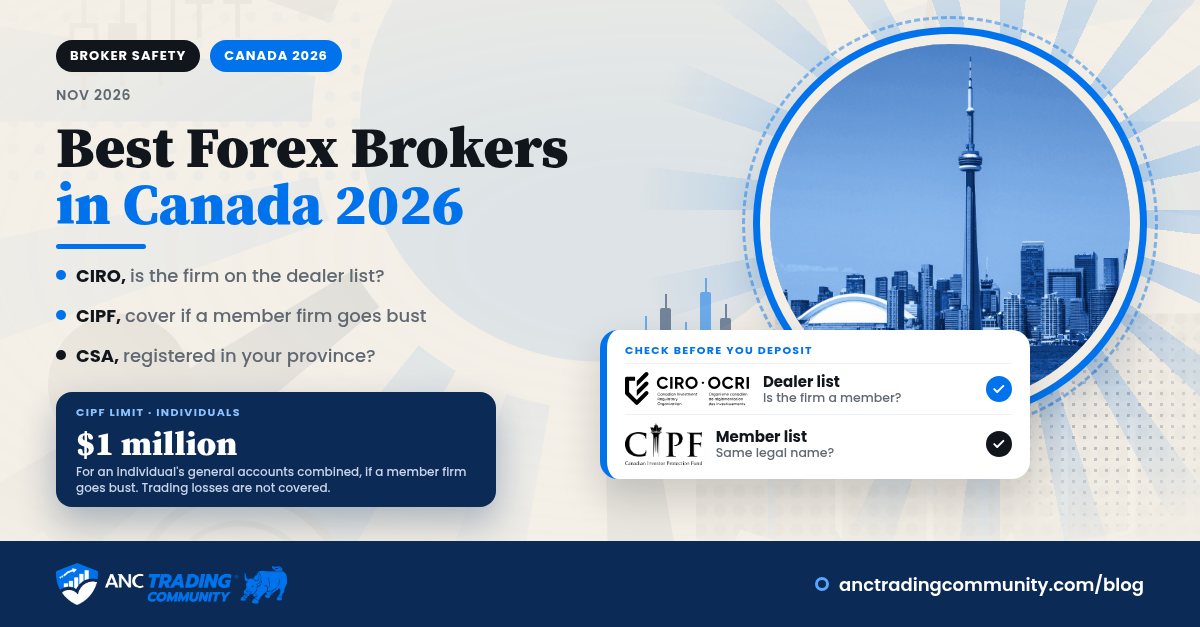
The best forex brokers in Canada are the ones you can check in two minutes. Each one should be a CIRO dealer member, a CIPF member and approved in your province. A tight spread means little if the firm is missing. So this guide, from ANC Trading Community, shows you how to check a broker yourself, how leverage works here, and what to compare once a broker passes.
Who Oversees Forex Brokers in Canada?
Canada has no single national market watchdog. Instead, each province and territory has its own. Examples include the Ontario Securities Commission and Québec’s Autorité des marchés financiers. Together, they form the Canadian Securities Administrators (CSA), which sets common rules. For a view of how this compares with other markets, see our brokers by country page.
Meanwhile, day-to-day oversight of dealers sits with the Canadian Investment Regulatory Organization (CIRO). According to CIRO and the Ontario Securities Commission, IIROC and the Mutual Fund Dealers Association of Canada merged on 1 January 2023. Then, on 1 June 2023, the new body took the name CIRO. You can join ANC Trading Community free and follow checks like these with the community.
Today, CIRO oversees investment and mutual fund dealers, plus trading on Canada’s stock and bond markets. So if a firm offers forex or CFDs to Canadians, you should find it in two places: CIRO’s list of dealers and the CSA’s National Registration Search. After that, you can line firms up on our broker comparison page.
What CIPF Covers, and What It Doesn’t
The Canadian Investor Protection Fund (CIPF) steps in when a CIRO member firm goes bust. It began on 1 January 2023, when the old CIPF and the MFDA’s own fund merged. This is the first filter we apply on our top broker listing.
According to CIPF, it covers client cash, shares and futures that a failed member can’t return. For one person, the limit is $1 million for all general accounts combined. On top of that, retirement accounts and certain education savings plans each get their own $1 million limit. Traders in ANC Trading Community use these limits when they weigh a firm.
However, CIPF is not trading insurance. It does not cover market losses, poor advice or products that don’t suit you, and it excludes crypto. In other words, it helps if the firm fails, not if your trade fails. Also, you must file a claim within 180 days. For a wider view of other markets, see our brokers by country page.
That matters to every trader who worries about getting money out. That is one reason the best forex brokers in Canada are CIPF members. An offshore broker has no such backing. For more, read our guide to segregated client funds and insurance protection.
How to Check the Best Forex Brokers in Canada
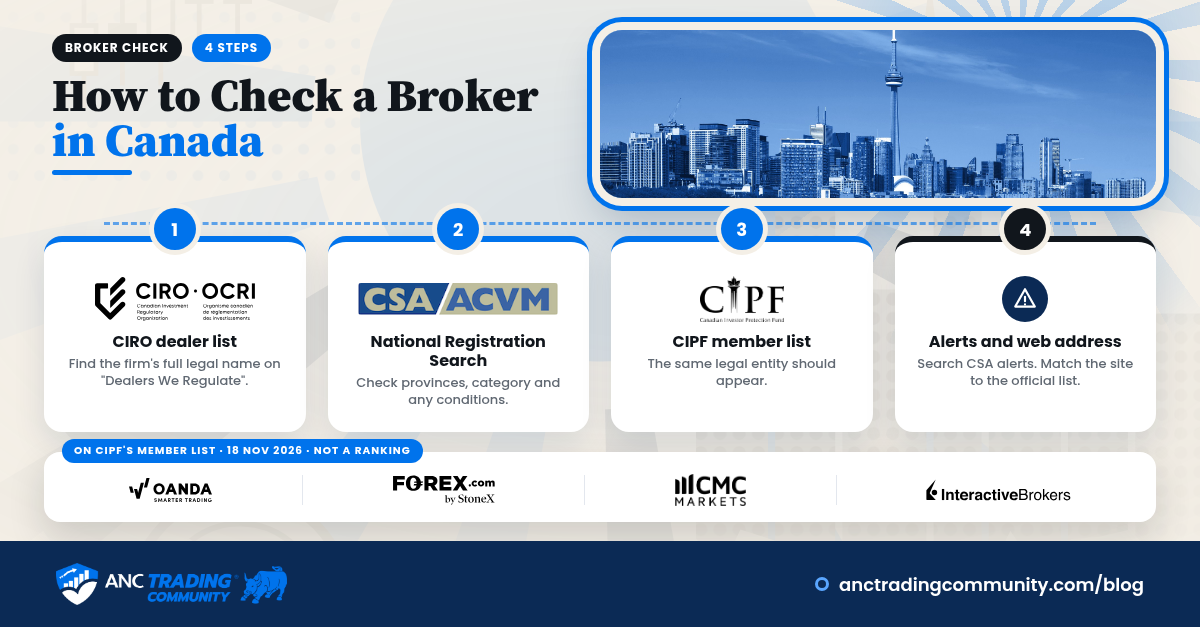
Start with the firm’s full legal name, not the brand on the app. Then run these four checks, which you can use alongside our top broker listing:
- Search CIRO’s dealer list. CIRO keeps a “Dealers We Regulate” list, so look for the firm there.
- Run the CSA National Registration Search. On the CSA National Registration Search, choose “Firm” and type the name. The result shows where the firm can work, its category and any conditions.
- Check the CIPF member list. The same legal name should appear there too.
- Look for alerts. Search the CSA’s investor alerts and CIRO’s disciplinary cases, then compare what you find with our broker comparison page.
Next, match the web address on the official list to the one you use. That is because CIRO warns that fraudsters clone websites and use look-alike web addresses with small typos or hyphens. Moreover, it says that a firm claiming to be regulated by CIRO isn’t proof that it is. You can also join ANC Trading Community free to work through these checks with the community.
Even the best forex brokers in Canada should pass all four checks, with no excuses. Keep our broker comparison page open as you go.
Leverage at the Best Forex Brokers in Canada
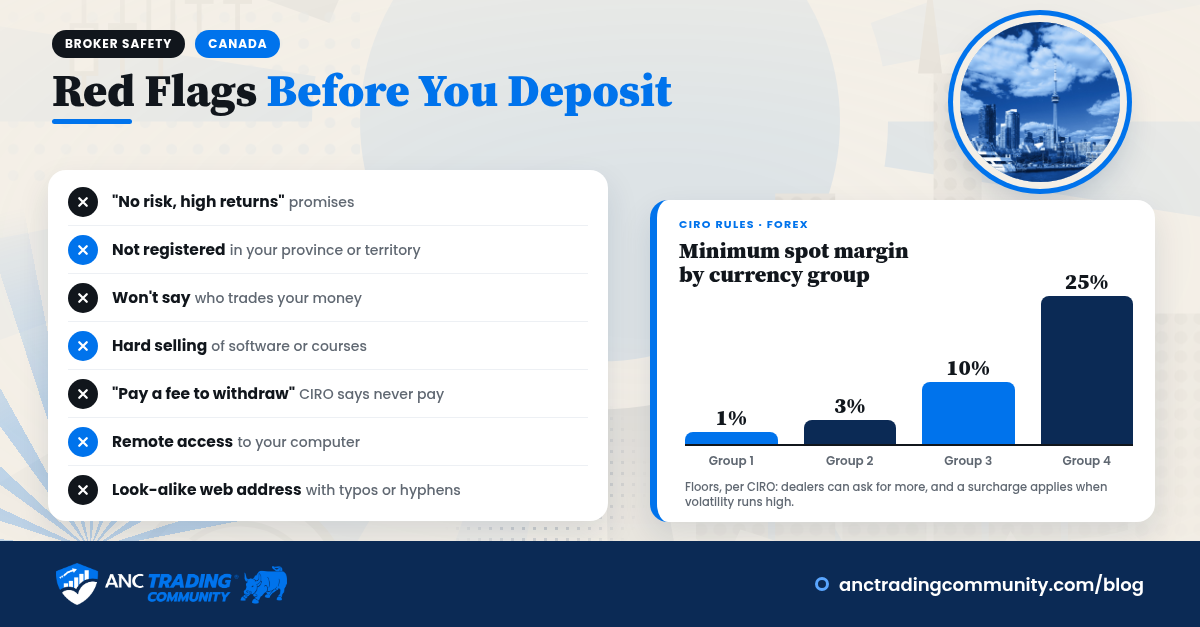
CIRO does not set one flat cap for forex leverage. Instead, its dealer rules sort foreign currencies into four groups. According to CIRO, the lowest margin rates for spot trades in those groups are 1%, 3%, 10% and 25%. On top of that, the rate goes up when a currency gets too volatile. Our top broker listing is a useful place to start comparing how firms apply this.
These rates are floors. A dealer can ask for more margin than CIRO does, but not less. As a result, leverage at the best forex brokers in Canada will differ by pair and by broker. For example, a 3% margin rate works out to roughly 33:1. So if a broker offers you far higher leverage, ask which rules it follows, and line this up firm by firm on our broker comparison page.
Offshore Brokers: The Real Risk
Some brokers that target Canadians online are not on any Canadian list. The CSA warns about such dealers that are “typically based outside of Canada where it can be difficult or impossible to protect or retrieve funds.” See our brokers by country page for markets that have a clear local register.
An offshore account may offer more leverage or a bonus. But if a withdrawal stalls, you have no Canadian body to complain to and no CIPF cover. That is why the best forex brokers in Canada, for most traders, are firms that pass every check above. ANC Trading Community is built around that same standard.
Red Flags Before You Deposit
The CSA and CIRO both list warning signs, and none should appear at any of the best forex brokers in Canada. So watch for these before you send a dollar, and keep our top broker listing to hand for firms that pass:
- A promise of little or no risk with high returns.
- No approval from a provincial or territorial securities body, which you can cross-check against our brokers by country page.
- Refusal to name who will trade your money, or to share a track record.
- Hard selling to buy a product, software or a course.
- A request for extra money before you can withdraw. CIRO says never pay a firm to release or recover your funds.
- A request to install remote-access software on your computer.
For more, our guide to the red flags of fake trading platforms covers more scam tricks.
What to Compare Among the Best Forex Brokers in Canada
Once a broker passes, compare cost and service. The best forex brokers in Canada should be clear on these points, which you can line up on our broker comparison page:
- Spreads and fees. Compare the all-in cost on the pairs you trade most, such as USD/CAD.
- Platforms. Some firms offer MT4 or MT5, others only their own app. For instance, OANDA’s Canadian site lists MT4 and TradingView, and CMC Markets’ Canadian site lists MT4 and MT5.
- CAD deposits and withdrawals. Check that you can fund in Canadian dollars, how fast withdrawals are and what currency fees apply.
- Swap. For example, holding a trade overnight costs or pays a fee. Our guide to swap-free forex accounts explains how swaps work.
Trading gold as well? Read our beginner’s guide to trading gold. Also, learn how to read the economic calendar before big Bank of Canada days.
Which Firms Are CIPF Members?
As of 18 November 2026, CIPF’s member list names several firms that offer forex trading in Canada. They include OANDA (Canada) Corporation ULC, GAIN Capital – FOREX.com Canada Ltd., CMC Markets Canada Inc. and Interactive Brokers Canada Inc. You can also browse these names on our top broker listing.
Still, this is not a ranking or an endorsement. Members can change, so use the same steps to judge any list of the best forex brokers in Canada. To look at other markets, see our brokers by country page or our guide to US forex brokers and CFTC rules.
FAQ: Best Forex Brokers in Canada
Is forex trading legal in Canada?
Yes. Forex trading is legal in Canada when you use a dealer approved in your province or territory. In practice, that means a CIRO member firm. Join ANC Trading Community free if you want help working through that check.
What is the maximum leverage for forex in Canada?
There is no single number. Instead, CIRO sets minimum margin rates by currency group, from 1% to 25%, and brokers can ask for more. Compare how this shows up in practice on our broker comparison page.
Is CIPF the same as CDIC?
No. CDIC protects eligible bank deposits at member banks. CIPF, by contrast, covers client property at CIRO member firms that go bust. Neither one covers trading losses. Our guide to segregated client funds and insurance protection goes deeper on this.
Can Canadians use offshore forex brokers?
Some offshore brokers accept Canadians, but the CSA says firms must register where they do business. So with an offshore broker, you give up CIPF cover and a Canadian watchdog’s help. Stick to firms you can find on our brokers by country page for Canada.
How do I pick the best forex brokers in Canada for beginners?
First, shortlist firms that pass the CIRO, CSA and CIPF checks. Then try a demo account and compare costs on USD/CAD, which you can do on our top broker listing.
Want the desk side of this? Join ANC Trading Community free for the analysis, tools and community. Choosing where to trade? Compare regulated brokers side by side on our broker comparison page, or browse our top broker listing to find the right fit.

Go Beyond the Charts, hosted by ANC Trading Community, is an exclusive FX VIP business meeting on 22 November 2026. It is free to join. So register to attend and meet leaders, brokers and serious traders in one room.
Watch: Candlestick Patterns for Beginners (Episode 2)
To go with this guide, watch the free lesson on candlestick patterns from ANC Trading Community.
Risk warning: Forex, gold and CFDs are complex and come with a high risk of losing money fast due to leverage. Most retail accounts lose money when trading CFDs. CIPF covers only eligible property at member firms that go bust, and never covers trading losses. This article is for information only and is not investment advice.