USD/JPY 160 is back on every trader’s screen, and Japan is warning again. The pair briefly traded above 160 on 12 and 13 November 2026, then closed Friday near 159.7. In reply, Finance Minister Satsuki Katayama said Tokyo will “respond appropriately”. For traders, that means two-way risk: the trend still points up, but one intervention day can knock the pair several yen lower in hours.
So this guide covers what happened, what officials said, Japan’s 2026 intervention record and the levels to watch. Whether you trade from Asia, Europe, the Middle East, Latin America or Africa, the yen story now moves the dollar, gold and global risk mood.
What Pushed USD/JPY to 160 This Week
The trigger came from the United States. October inflation data came in hotter than traders thought, and markets quickly priced a Federal Reserve rate hike at the 8 to 9 December meeting. As a result, US two-year yields jumped. MUFG Research put that jump at 45 basis points for the week.
USD/JPY follows US yields closely. FOREX.com analysts noted that the pair had traded between 156.68 and 159.00 for most of two months. Then the yield shock pushed it through the top of that range.
How high did USD/JPY go?
Daily price data shows a high near 160.19 on 13 November, after a first push above 160 the day before. Exact highs differ a little by data feed. However, the pair could not hold above USD/JPY 160 and closed the week at about 159.7. In other words, buyers tested the line, and sellers pushed back.
What Japan’s Officials Said About USD/JPY 160
Tokyo met the move with words first. Two officials matter most here.
Atsushi Mimura, 12 November
Japan’s top currency diplomat, Vice Finance Minister Atsushi Mimura, said recent moves had been far too fast. Reuters quoted him: “It’s still too early to forget what happened this summer.” That was a clear nod to the summer interventions.
Satsuki Katayama, 13 November
The next day, Finance Minister Satsuki Katayama spoke to the press at her regular news event. Reuters reported her words: “Recent movements in the foreign exchange market have been one-sided and rapid.” She added: “We will continue to work closely with the US Treasury and respond appropriately.”
Notice the words used around USD/JPY 160. “One-sided” and “rapid” are the words Tokyo tends to use before it acts. Still, officials never promise a date or a level.
Japan’s 2026 Intervention Record
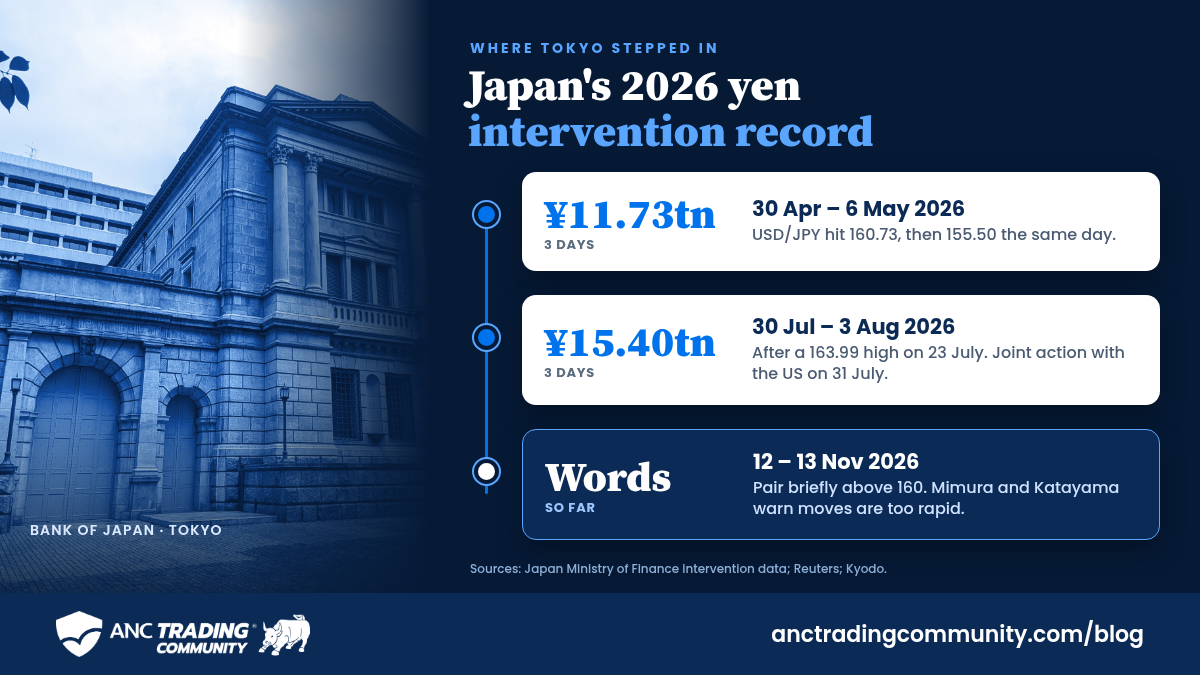
This is why traders take warnings near USD/JPY 160 to heart. Japan has already stepped in twice this year, Ministry of Finance data shows.
- 30 April to 6 May 2026: ¥11.73 trillion over three days. Reuters said that on 30 April the pair dropped from as high as 160.725 to 155.50.
- 30 July to 3 August 2026: ¥15.40 trillion over three days, a record. This came after the pair hit 163.99 on 23 July, Kyodo reported. The 30 July move alone was ¥7.98 trillion.
- 31 July 2026: the United States joined in. A New York Fed report said it bought ¥79.4 billion that day, its first yen-buying intervention since 1998.
In each case, the yen bounced hard and then slid again over the next few weeks. So intervention buys time. It does not change the rate gap by itself.
Who decides intervention in Japan?
The Ministry of Finance decides when to intervene. The Bank of Japan then carries out the trades as its agent. That is why traders near USD/JPY 160 watch the finance minister and Mimura most closely.
Why USD/JPY 160 Matters but Is Not a Hard Line
Many traders treat 160 as a trigger. In reality, analysts say Tokyo focuses on the speed of a move, not a fixed level.
For example, Commonwealth Bank of Australia strategist Samara Hammoud said on 13 November: “We see intervention risk rising materially on a rapid or sustained break above 160.” Meanwhile, MUFG Research said it assumes intervention between 160 and the 2026 high of 164.
The rate gap problem
The Bank of Japan held its policy rate at 1.25% on 30 October in an 8 to 1 vote. One board member wanted 1.5%. Its next meeting is on 17 and 18 December. Meanwhile, the Fed may still hike first. As long as US rates rise faster, the yen stays weak.
Key Levels for USD/JPY 160 Traders
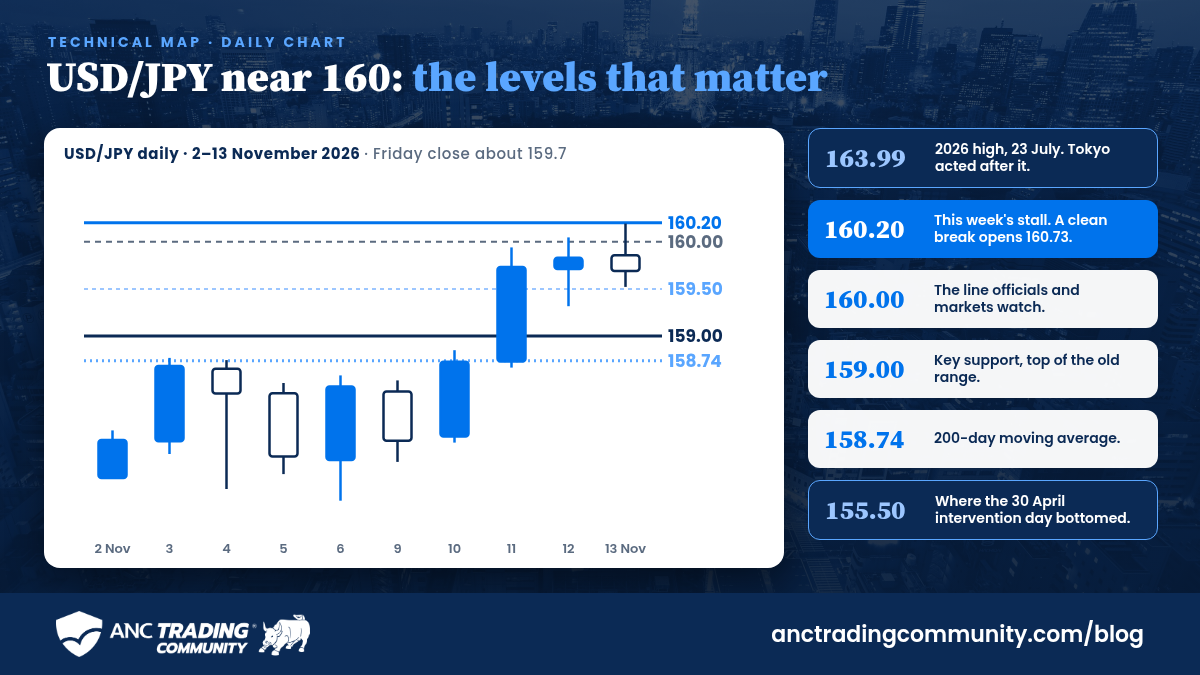
These USD/JPY 160 levels come from the daily chart and the FOREX.com weekly outlook. Treat them as a map, not a promise.
- Resistance: 160.20, where this week’s rally stalled. Above that sits 160.73, then 162.84 and the 2026 high of 163.99.
- Support: 159.50 first, then 159.00. The 200-day moving average sits near 158.74.
- Intervention zone: if Tokyo acts, history shows a fast drop of several yen. On 30 April, the pair fell about five yen in one session.
How to Trade USD/JPY Near 160
Here is how we trade it on the ANC desk.
- Cut your size. A gap of several yen can blow through normal stops. So risk less per trade while officials are talking.
- Expect slippage. Stops may fill far from your level in a fast move. Therefore, set your risk on the worst fill, not the ideal one.
- Do not chase longs at the line. Buying right under USD/JPY 160 means you face the trend’s best price and Tokyo’s biggest threat at once.
- Watch thin markets. Reuters said the spring intervention likely ran during Japan’s Golden Week holidays, when markets were thin. Holidays and late New York hours deserve extra care.
- Track the calendar. US data, the Fed on 8 to 9 December and the Bank of Japan on 17 to 18 December can all move the pair. Keep our economic calendar open.
What it means for gold and the dollar
A strong dollar also weighs on gold. Our piece on why gold is falling this week shows that link. You can also read how the gold and dollar correlation shifts and our earlier note on US dollar strength and momentum. New to gold? Start with our gold trading guide for beginners.
FAQ: USD/JPY 160 and Yen Intervention
What is yen intervention?
It is when Tokyo buys or sells yen in the FX market to slow a sharp move. In 2026, Tokyo has sold dollars and bought yen to back its money.
Why does USD/JPY 160 matter?
Japan acted when the pair moved past 160 in 2024 and again in April 2026, Reuters said. So traders see 160 as a warning zone, though analysts say Tokyo focuses on speed.
Has Japan intervened in 2026?
Yes. Ministry of Finance data shows ¥11.73 trillion from 30 April to 6 May and ¥15.40 trillion from 30 July to 3 August.
Who decides when Japan intervenes?
The Ministry of Finance decides. The Bank of Japan then places the trades in the market for the ministry.
What happens to USD/JPY after intervention?
Usually, the pair drops fast. On 30 April 2026 it fell from about 160.7 to 155.5. However, the yen slid again in the weeks after, both times.
Will Japan intervene again at 160?
Nobody knows in advance. Officials have warned that moves are rapid, but they never say in advance when they will act. So plan your USD/JPY 160 risk for both cases.
Want our desk view on USD/JPY 160 and the yen? Join ANC Trading Community free for the analysis, tools and community. Choosing where to trade? Compare regulated brokers side by side on our broker comparison page, or browse our top broker listing to find the right fit.

Go Beyond the Charts, hosted by ANC Trading Community, is an exclusive FX VIP business meeting on 22 November 2026. It is free to join. So register to attend and meet leaders, brokers and serious traders in one room.
Risk warning: Forex and CFDs are complex instruments and come with a high risk of losing money rapidly due to leverage. A high percentage of retail investor accounts lose money when trading CFDs. Central bank intervention can cause sudden gaps and slippage. This article is for information only and is not investment advice. We checked all figures on 15 November 2026, and they may change.
Explore more practical guides on the ANC Stock Investments blog.